Expanding Distribution Grids Efficiently: New Challenges Call for New Solutions
The demands on Germany’s distribution grids are undergoing a fundamental shift: While grid expansion in many places is still driven by the integration of renewable energy sources, new electricity consumers such as heat pumps and electric vehicles will increasingly determine grid dimensioning in the future. The new study “Cost-Effective Expansion of the Distribution Grid” by Agora Energiewende, FfE, and Consentec examines the resulting grid expansion needs and how innovative measures can help make better use of existing grids and make the necessary expansion more cost-effective.
From Feed-in to Load-Driven Grid Expansion
Today, solar and wind energy are the primary drivers of grid expansion needs in many regions. As electrification increases, this picture is changing: electric vehicles, heat pumps, and other new electricity con-sumers mean that, in the long term, peak loads will play an increasingly critical role in the design of distribution grids.
This also shifts the requirements for cost-effective grid expansion. While feed-in-related bottlenecks primarily require better utilization of existing grid capacity and management of infrequent feed-in peaks, the targeted use of flexibility on the consumption side is gaining importance as expansion becomes increasingly load-driven.
Innovative Measures Can Reduce Grid Expansion
The study examines various approaches to make better use of existing grids and to reduce or postpone the necessary expansion. These include, among other things, capping infrequent feed-in peaks, the shared use of grid connections by renewable energy sources and storage systems, higher utilization of existing grid assets, and the targeted control of flexible loads.
The results also show that not every measure is equally effective at every point in time and in every grid. Which approaches can make the greatest contribution depends, among other things, on whether grid expansion is driven by feed-in or by loads.
Billions in Potential Through More Efficient Grid Use
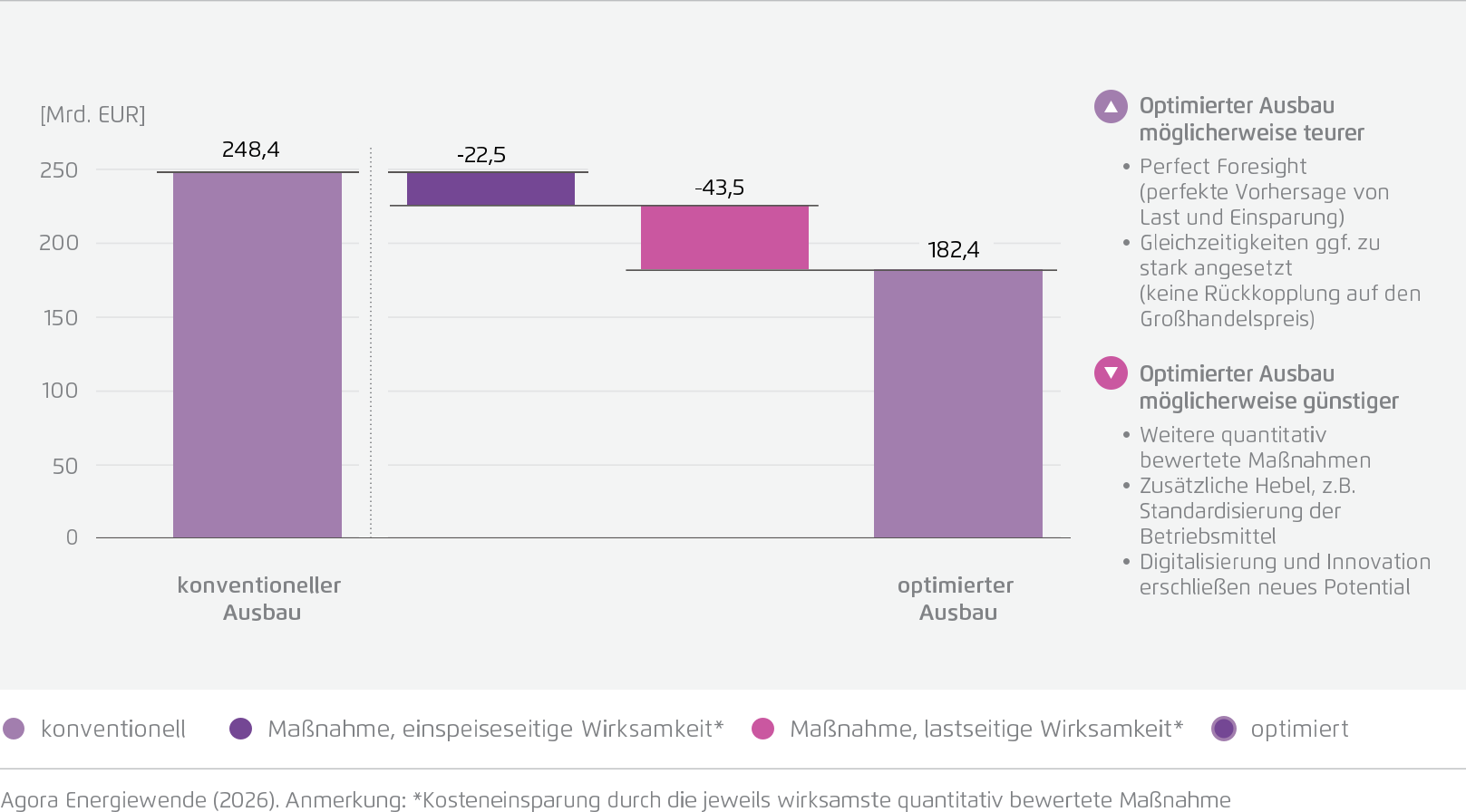
A preliminary synthesis of the most effective measures examined illustrates the scale of the potential: The modeled expansion costs through 2045 could drop from approximately 248 to 182 billion euros. This corresponds to a reduction of approximately 66 billion euros, or 27 percent.
It should be noted that the measures examined do not replace grid expansion. However, they can help make more efficient use of existing infrastructure, invest more strategically, and better align grid expansion with changing demands.
Figure 1: Potential savings on grid expansion costs until 2045 (German only)