The German transmission system operators (TSOs) have once again commissioned FfE to model the development of industrial electricity, methane, hydrogen and derivative consumption in Germany up to 2045. In FfE’s own Sector Model Industry (SMInd), final energy demand and maximum connection capacities resulting from decarbonisation and economic development are represented and regionalised at district level. Building on the methodology of the previous project for the 2023 Network Development Plan (NDP), new scenario frameworks and transformation pathways were developed, and the industrial site database was updated. The results feed into the draft scenario framework for the 2027 NDP and provide a differentiated basis for planning future infrastructure.
Methodology
The starting point for the modelling is the base year 2023. First, the development of industrial electricity consumption from 2019 to 2023 was analysed in order to reflect pandemic- and energy-crisis-related production declines, site closures and structural changes in the baseline. SMInd then projects the status quo forward, combining assumptions on production volumes, gross value added and efficiency with new processes, fuel switching and carbon capture. Energy-intensive industry is modelled bottom-up and at site level.
For the national transformation, the study uses two FfE scenario frameworks: the trend scenario describes what FfE considers the most likely pathway to climate neutrality by 2045 and accounts for short- to medium-term delays. The target scenario represents an ambitious and rapid transformation. Within both frameworks, industrial final energy demand was calculated for a high degree of electrification as well as for high hydrogen use and incorporated into NDP scenarios A and C. The pathways are not based on technological extremes, but on techno-economic assessments validated with stakeholders. As a result, electrification plays a larger role than in the previous study even in the hydrogen pathway, particularly for low- and medium-temperature applications.
A key element is the regionalisation of future industrial electricity and hydrogen demand at district level. Based on FfE’s industrial site database, electricity-intensive processes and economic sectors are localised. Process-related demand is derived from production volumes and specific consumption values; the remaining electricity demand is distributed iteratively based on employment figures. Regional and national electricity consumption statistics as well as TSO reports on large consumers remain consistent. For subsequent grid planning, maximum connection capacities are also calculated. This is based on a year-independent type-day time series for industrial economic sectors developed in the previous project.
Results
Total final energy consumption remains in a similar range across the three transformation pathways, at around 480 to 500 TWh in 2045, while its composition changes significantly compared with the status quo. Figure 1 compares final energy consumption in 2023 with the three transformation pathways in 2045. The stacked bars show how total final energy consumption is distributed across energy carriers such as electricity, hydrogen, methane, biomass and other fuels.
The figure shows that electricity becomes the central energy carrier in all scenarios, particularly due to new technologies in heat supply and basic chemicals. At the same time, hydrogen remains indispensable for selected processes in the steel and chemical industries as well as for high-temperature heat. The differences between the hydrogen and electrification pathways are most evident in the provision of process heat; heat applications account for around 290 TWh in the target year. The two electrification pathways differ less in aggregated electricity and hydrogen consumption in 2045 than in the timing of the transformation. The results were largely incorporated into the new scenario framework.
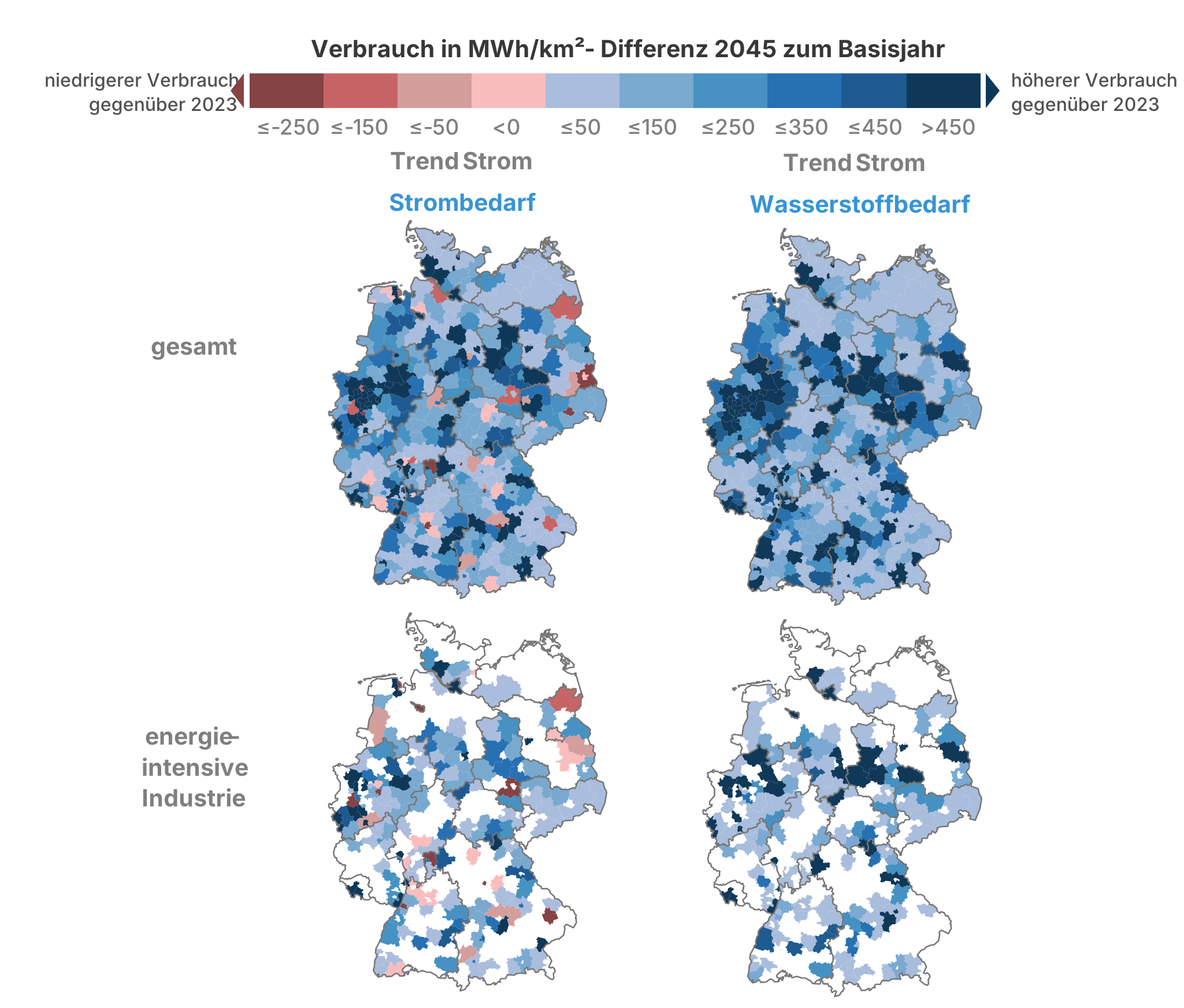
In addition to the national energy carrier structure, the spatial distribution of future demand is crucial. Figure 2 shows the changes in industrial electricity and hydrogen demand in the trend scenario up to 2045 compared with 2023, both for industry as a whole and for energy-intensive industry. The German caption refers to regional change. The maps therefore do not show absolute demand, but where demand increases or decreases across German districts.
Figure 2: Regional changes in industrial electricity and hydrogen demand in the trend scenario through 2045 (German only)
The maps make the regional patterns behind the aggregated scenario results visible. Additional electricity demand arises especially where energy-intensive processes are electrified or new process routes are implemented. Hydrogen demand is concentrated in existing industrial clusters in the steel and chemical industries as well as in other high-temperature processes. At the same time, declining production volumes and site closures can lead to decreasing electricity consumption in individual districts. For readers unfamiliar with German geography, the figure is mainly intended to identify regional hotspots rather than individual locations.
The comparison with the Langfristszenarien which we conducted in this project highlights the added value of the updated modelling: infrastructure requirements strongly depend on assumptions about future domestic production, imports and the international competitiveness of energy-intensive industries. In the Long-Term Scenarios, electricity and hydrogen consumption in 2045 is significantly higher than in the FfE study. This is due less to technological differences than to higher assumptions regarding the remaining production of basic materials in Germany, particularly in the chemical industry. NDP scenario B accordingly assumes higher hydrogen and methane consumption. The study therefore shows which ranges are relevant for grid and infrastructure planning and where regional focal points of industrial transformation are emerging.
Cookies on Website
We use cookies to ensure that we give you the best experience on our website. Read our privacy policy for more information.
Cookies on Website
We use cookies to ensure that we give you the best experience on our website. Read our privacy policy for more information.